

It’s 10:00 AM on a Tuesday in Manhattan. Your Controller receives a call. The voice on the other end is unmistakable: it’s your CEO. He’s at a conference in London, sounding slightly stressed, asking for an emergency wire transfer to close a "time-sensitive" vendor deal.
The caller ID is correct. The voice has the CEO’s specific cadence and dry humor. Your Controller, wanting to be helpful, initiates the transfer.
It’s a lie.
The voice wasn't your CEO. It was a real-time AI voice clone generated from a three-minute clip of a podcast he did last month. This isn't a scene from a sci-fi movie; it is the daily reality for New York businesses in June 2026.
As we move deeper into this year, the "classic" phishing email, the one with the bad grammar and the suspicious link from a "Prince", is officially dead. In its place is a highly industrialized, AI-powered assault that is bypassing traditional security at an alarming rate. If you aren't prepared, your data is already on the clock.
The Explosive Rise of AI-Driven Social Engineering
We’ve reached a tipping point. By mid-2026, threat analysts have reported a staggering 1,265% increase in AI-linked phishing attacks.
Today, over 80% of all phishing attempts are generated by Artificial Intelligence. This means the "tells" we used to teach employees, checking for typos or hovering over weird URLs, are no longer enough. AI now crafts grammatically perfect, context-aware lures that mimic your company’s internal tone of voice with chilling accuracy.

In New York, where high-stakes finance and legal sectors are prime targets, the threat has evolved into what experts call "all-green" fraud. This occurs when an employee is so convincingly social-engineered that they use their legitimate credentials on their legitimate device to perform a malicious action. Every technical control in your system shows "green" (authorized), but the money or data is already gone.
Why MFA and Traditional Backups Are Failing
For years, we told you that Multifactor Authentication (MFA) was the silver bullet. In 2026, it’s just the first hurdle. Modern phishing kits now integrate MFA bypass techniques and session hijacking. Attackers aren't just stealing passwords; they are stealing the active session tokens that tell your cloud apps you've already logged in.
Furthermore, ransomware has become smarter. Once an attacker gains entry through a deepfake or a hyper-personalized email, their first move isn't to encrypt your files, it’s to find and destroy your backups.
If your backup is sitting on the same network as your production data, it’s not a safety net. It’s a sitting duck.
The NYDFS 2026 Compliance Wall
If you are a financial institution or a regulated entity in New York, the stakes are legally binding. The NYDFS Cybersecurity Regulation (23 NYCRR Part 500) has reached a critical milestone. As of the April 15, 2026 filing, firms must certify full compliance with amended requirements, including:
- Enhanced Asset Inventory: You must know exactly where every byte of sensitive data lives.
- Mandatory MFA: Required for any individual accessing your systems, but with the caveat that you must now prove you are monitoring for MFA bypass attempts.
- 24-Hour Ransomware Reporting: If you pay a ransom, you have one day to tell the state why.
Staying compliant isn't just about avoiding a fine; it’s about ensuring that a single "click" from a misled employee doesn't shutter your business for good. You can read more about staying ahead of these shifts in our compliance and regulations section.
The Ultimate Safety Net: Immutable Backup
When your front-line defenses fail, and in 2026, the data says they eventually will, you need a "Plan Z." That plan is an immutable backup built into a stronger cloud based disaster recovery strategy.
So, what is an immutable backup? In plain English, it is a copy of your data that cannot be changed, deleted, or encrypted for a set period. In a modern cloud based disaster recovery environment, that gives your business a clean recovery point even after an attacker has moved through production systems.

Think of it like writing in permanent ink vs. pencil. Traditional backups can be "erased" by a hacker with admin credentials. An immutable backup uses WORM (Write Once, Read Many) technology. Even if a ransomware script gets into your system and tries to "delete all," the immutable vault simply says "No."
For New York firms dealing with high-volume transactions, this is the only way to guarantee a Zero-Error recovery.
Why your business needs it NOW:
- Ransomware Immunity: Hackers can't encrypt what they can't modify.
- Insider Threat Protection: An angry employee with admin rights still can't wipe the immutable repository.
- Regulatory Peace of Mind: It satisfies the most stringent data protection requirements for New York State.
Air-Gapped Backup: The Final Fortress
If immutability is permanent ink, an air gapped backup is a vault buried underground with no wires leading to the surface.
In a world where AI can scan your network for vulnerabilities in seconds, "logical" isolation isn't always enough. An air gapped backup creates a physical or logical disconnect between your primary network and your backup data. As part of a layered cloud based disaster recovery plan, it gives you one more barrier between a live attack and your last clean copy of critical business data.
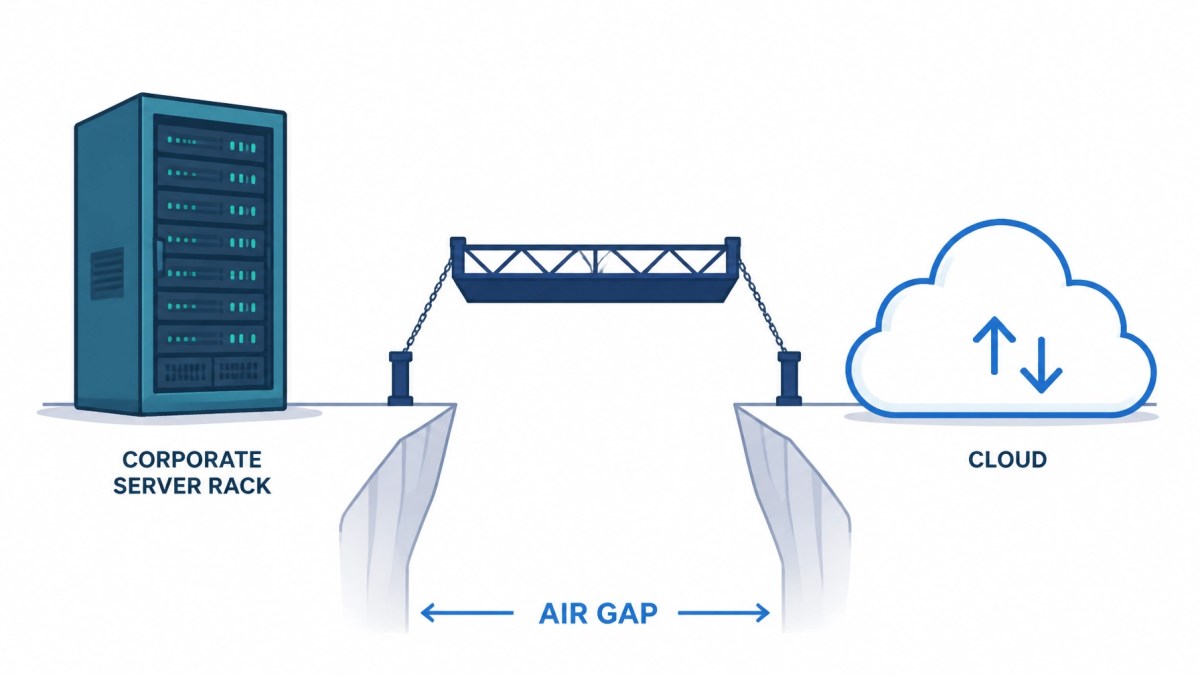
When the backup isn't actively running, there is no path for a hacker to travel from your infected workstation to your backup files. It is the digital equivalent of pulling the plug.
At Ron Klink – Disaster Recovery Solutions, we specialize in designing resilient infrastructure that utilizes both immutable storage and air-gapped protocols. This multi-layered approach ensures that even if a deepfake convinces your top executive to hand over the keys, the "backup vault" remains untouched and invisible to the intruder.
Your 2026 Action Plan: Moving from Reactive to Proactive
You cannot stop AI from evolving, but you can stop it from winning. Here is how you protect your New York firm today:
| Strategy | Action Step | Why It Matters in 2026 |
|---|---|---|
| Verify Out-of-Band | Implement a "double-check" policy for all financial moves. | Bypasses voice clones and deepfakes. |
| Audit Immutability | Ensure your current cloud backup is truly immutable. | Prevents backup deletion during a breach. |
| Test the Air-Gap | Perform a recovery test from an isolated environment. | Confirms your "last resort" actually works. |
| Update Training | Move beyond "don't click links" to "identify social engineering." | Prepares staff for AI-driven manipulation. |
Don't Wait for the "Emergency" Call
The cost of downtime in the New York market is higher than ever. Between lost billable hours, reputational damage, and the looming threat of NYDFS penalties, a "wait and see" approach is a gamble you will lose.
It’s time to act.
If you aren't 100% sure that your data is protected by an immutable backup or an air gapped backup solution, you are vulnerable. At Ron Klink – Disaster Recovery Solutions, we help NY businesses build the "Final Fortress" around their digital assets with practical cloud based disaster recovery strategies.
Stop the threat before it starts. Contact us today for a comprehensive review of your disaster recovery posture. Let’s make sure that when the AI comes knocking, your door is bolted from the inside.


