

The sky over Dutchess County turns an unnatural shade of bruised purple. Within minutes, the wind-driven rain is blinding, and the hum of your office servers is silenced by a sharp, metallic pop. The power is out. Across New York, from the high-rises of Manhattan to the industrial parks of Buffalo, this scene is playing out with terrifying frequency this July.
As of July 22, 2026, New York has already faced a brutal summer of "grid-stress" events. Governor Hochul recently cited over 82,000 concurrent outages statewide during a single storm cycle, with some areas waiting days for restoration. While your local utility works to clear downed lines, a more silent disaster may be unfolding inside your hardware.
Your data is at its most vulnerable the moment the lights flicker.
If you think your nightly cloud sync has you covered, you are betting your business on a "standard" backup that may not survive the physical and logical chaos of a New York summer storm. It is time to ask: Is your data protected by a true immutable backup, or is it just another file waiting to be corrupted?
The "Invisible" Threat of Sudden Power Failure
When a storm hits, most business owners worry about flooded basements or smashed windows. However, for your digital infrastructure, the real threat is the abrupt termination of processes.
A sudden power loss doesn't just stop your computer; it can leave files "half-written." If your system was in the middle of a backup sync when the transformer blew, that backup is now incomplete, or worse, corrupted. Standard backups are fragile. They are designed for easy overwriting and deletion, which makes them convenient for daily use but useless when a power surge scrambles their logic.
Furthermore, these outages often serve as a "smoke screen" for cybercriminals. Bad actors know that during a crisis, your IT team is distracted by physical repairs. If ransomware is introduced while your systems are unstable, a standard backup can be encrypted or deleted in seconds. This is why we stressed in our recent guide on The June 1st Hard Deadline: Why Hurricane Preparedness Can’t Wait Another Week that physical readiness and digital resilience must go hand-in-hand.
Defining the New Standard: What is an Immutable Backup?
In the world of disaster recovery, "immutable" is a fancy way of saying "unchangeable."
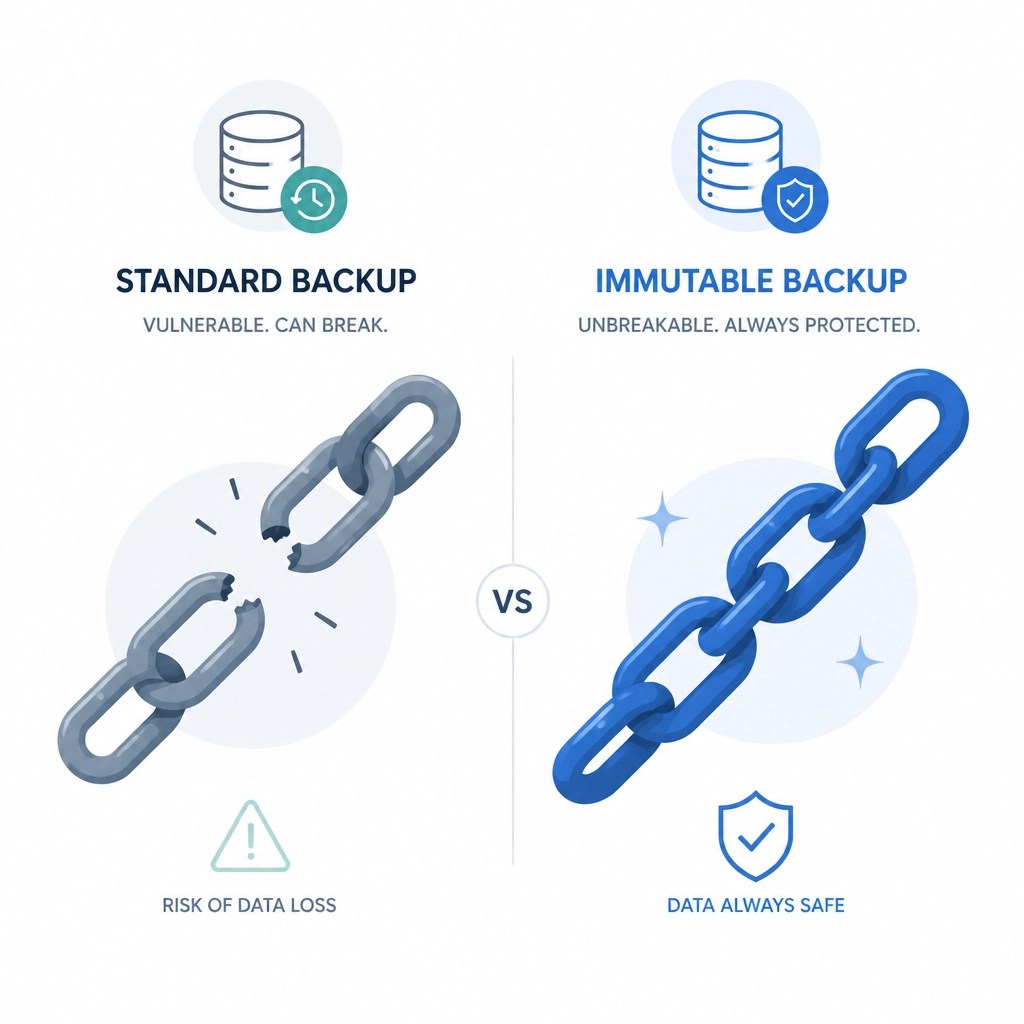
An immutable backup is a data set that is locked the moment it is created. It cannot be modified, encrypted, or deleted by anyone, not even an administrator with full system privileges, for a specific period.
Think of a standard backup like a whiteboard. You can write on it, erase it, and change the numbers whenever you want. If a hacker gets hold of the eraser, your data is gone. An immutable backup is like a stone tablet. Once the data is "etched" into the storage, it is permanent until the timer expires.
Why Immutability is Non-Negotiable in 2026:
- Protection Against Ransomware: If your live data is encrypted, you simply roll back to your immutable copy. The hackers can't touch it.
- Corruption Resilience: Because the data is locked, a power surge cannot "half-write" over an existing good backup.
- Compliance: In 2026, many New York industries are now legally required to maintain tamper-proof records to meet evolving state privacy laws.
New York’s Unique Risk Profile: From the Coast to the North Country
New York businesses face a "double-jeopardy" weather scenario.
In Coastal New York and Long Island, we deal with high-salinity air and the constant threat of storm surges that can physically destroy local backup appliances. If your only backup is a NAS (Network Attached Storage) sitting in a server room in Queens, a flooded basement means you have zero data.
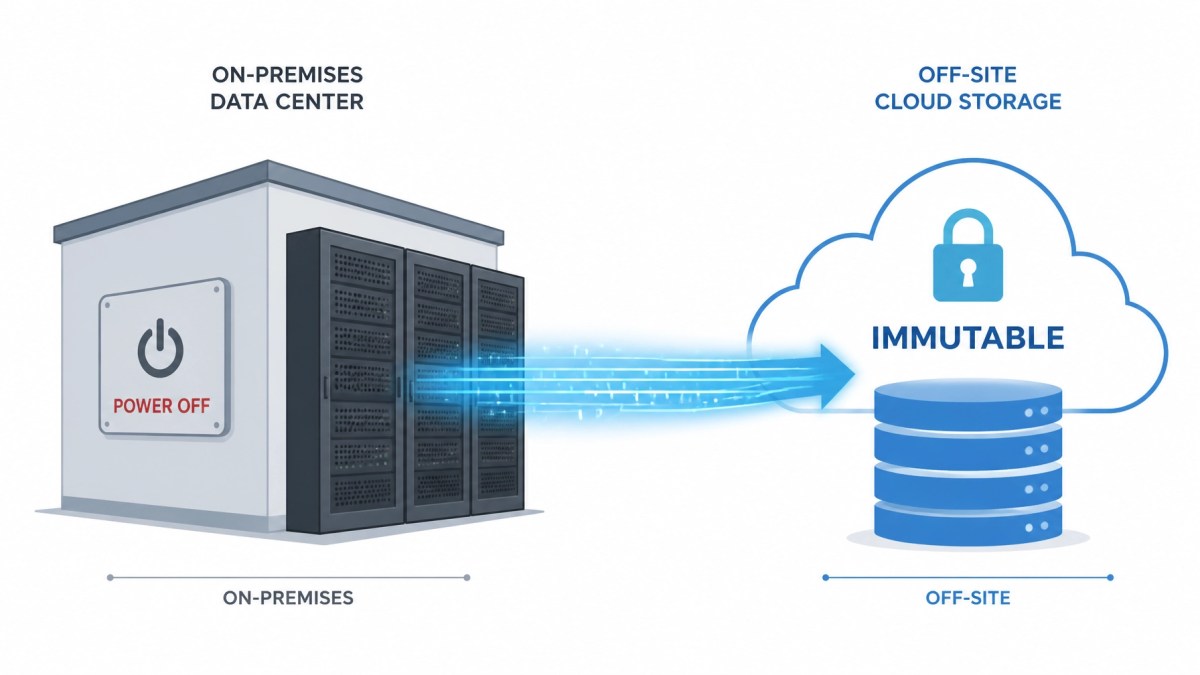
Upstate New York, meanwhile, faces a different beast: the "Macroburst." These localized, high-intensity wind events have already caused massive outages in the Hudson Valley this month. When a tree takes out a pole in a rural area, restoration can take 72 hours or more. Without a cloud-based immutable backup, your business remains paralyzed while the grid is repaired.

The Sync-Failure Trap: Is Your Data Actually Locked?
Many businesses claim to have immutable backups, but their architecture has a fatal flaw: the Sync Gap.
If your server loses power at 2:05 PM, but your immutable sync doesn't finish until 3:00 PM, you haven't just lost an hour of work, you might have triggered a "partial write" error that prevents the entire data set from being marked as immutable.
At Ron Klink, we solve this by designing resilient infrastructure that uses Micro-Snapshots. Instead of one giant, vulnerable backup at night, we capture small, immutable "slices" of your data throughout the day. If the power goes out, the "slices" that were already finished are safely locked away, ensuring you only lose minutes of data, not days.
| Feature | Standard Backup | Immutable Backup |
|---|---|---|
| Editable? | Yes, by any admin | No, locked for a set duration |
| Ransomware Protection | Low (Can be encrypted) | Absolute (Cannot be altered) |
| Power Surge Risk | High (File corruption) | Low (Previous versions stay safe) |
| NY Storm Ready? | No | Yes |
3 Urgent Checks for Your Data Immutability
Don't wait for the next lightning strike to find out if your recovery plan works. Do these three things today:
- Verify the "Lock" Policy: Contact your IT provider and ask: "Is our backup storage using S3 Object Lock or a similar WORM (Write-Once-Read-Many) technology?" If they can't give you a technical 'yes,' your data is at risk.
- Test the Restore During an Outage Scenario: It’s one thing to restore data when everything is perfect. Can you restore your immutable backups to a completely different location (like an Azure or AWS instance) if your local office has no power?
- Check the Retention Timer: Ensure your immutability period is long enough to cover a multi-day outage. If your "lock" only lasts 24 hours but it takes 48 hours to get your power back, you might find yourself in a race against the clock you can't win.
Conclusion: Resilience is a Local Game
The 2026 storm season is proving that the "Old New York" way of doing IT: buying a server and hoping for the best: is a recipe for bankruptcy. Downtime in 2026 costs the average mid-sized NY business upwards of $10,000 per hour. You cannot afford to hope.
At Ron Klink – Disaster Recovery Solutions, we don’t just sell software; we build survival plans. We understand the specific stresses of the New York power grid and the unique weather patterns that threaten our local economy. From Azure Site Recovery to AWS Elastic Disaster Recovery, we customize immutable backup solutions that ensure when the lights go out, your data stays on.
Stop gambling with the weather.
Contact Ron Klink today for a comprehensive Resilience Audit. We will map your infrastructure, identify your single points of failure, and lock your data behind an immutable shield before the next storm rolls in.


